
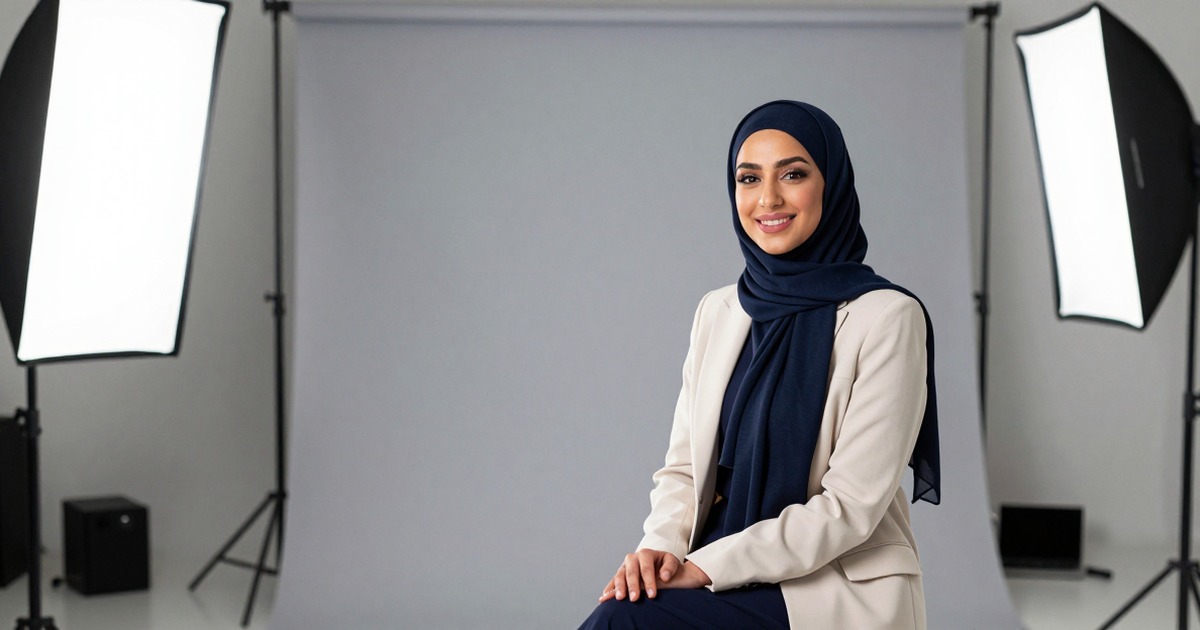
Professional headshots should represent who you are. For millions of professionals who wear hijab, turban, kippah, or other religious head coverings, that means a headshot that looks polished, current, and respectful of their faith.
This should be straightforward, but traditional photography has a mixed track record here. Many photographers lack experience working with religious head coverings. Lighting setups designed for bare heads don't always work the same way with fabric. Color coordination between covering, outfit, and background requires intentional thought. The awkward moment when a photographer suggests removing a covering "for just one shot" still happens more often than it should.
AI headshot generators offer a different experience. You train the model on photos of yourself as you actually appear. The AI learns your face WITH your covering as part of your natural appearance. It generates professional photos accordingly.
Why This Matters
Religious head coverings are worn by professionals across every industry:
- Hijab worn by Muslim women in diverse styles, from simple wraps to elaborately styled pieces
- Turban worn by Sikh men as a central part of their faith, and by others for religious or cultural reasons
- Kippah/yarmulke worn by observant Jewish men
- Tichel/sheitel worn by married Orthodox Jewish women
- Modest dress practices across many faiths that influence headshot styling
In 2026, these professionals need headshots for the same platforms as everyone else: LinkedIn, company websites, speaking engagements, client-facing materials, and industry directories. The headshot should look professional. It should also look like them.
Common Problems with Traditional Photography
Professionals who wear religious head coverings report several recurring issues with standard headshot photography:
Lighting challenges. Studio lighting setups are typically calibrated for bare heads. Head coverings change how light falls across the face, potentially creating harsh shadows or losing detail in darker fabrics. Photographers who don't adjust for this produce flat or unflattering results.
Color clashes. The background, outfit, and covering need to work as a color palette. Many photographers default to backgrounds that clash with common covering colors. They don't think about the three-way coordination.
Incorrect framing. Standard headshot framing assumes a certain head shape and hair arrangement. Head coverings change the silhouette. Photographers who don't adjust their framing can make the covering look like an afterthought rather than an intentional part of the presentation.
Styling unfamiliarity. A photographer who has shot hundreds of headshots but none with a turban or hijab may not know what "good" looks like. They can't guide you toward your best angles or suggest adjustments they've never needed before.
Uncomfortable requests. Some professionals report being asked to remove or adjust their covering in ways that feel disrespectful. This shouldn't happen, but it does. It turns what should be a simple professional task into an uncomfortable situation.
How AI Headshots Handle Religious Head Coverings
AI headshot generators that train personalized models like Narkis.ai learn your appearance from photos you upload. If you wear a hijab in your training photos, the AI learns that your hijab is part of your appearance. The generated headshots include it naturally.
This approach has several advantages:
No external judgment. There's no photographer to have opinions about your covering. The AI treats it as part of your face, which is exactly what it is to you.
Consistent quality. The AI applies professional lighting and composition regardless of head covering style. It doesn't need to "adjust" for your covering because it learned your appearance with it.
Style variety. If you wear your covering in different styles, include multiple styles in your training photos. The AI can then generate headshots with different looks.
Color coordination. Generate headshots with different background options and pick the ones that complement your covering's color and style. No need to hope the photographer's backdrop works with what you're wearing.
Getting the Best Results
Training Photo Tips
Include your typical covering styles. If you wear your hijab differently for work versus casual settings, include both. If your turban is always the same style, show it from multiple angles.
Show color variety if applicable. If you wear different colored hijabs or scarves, include several in your training photos. This gives the AI more flexibility in generated results.
Pay attention to lighting on fabric. Take training photos in good natural light. This helps the AI understand how light interacts with your specific covering material, whether matte, silk, or jersey.
Include close-up face shots. Make sure several photos clearly show your face regardless of how much of your covering is visible. The AI needs to learn your facial features distinctly.
Standard advice still applies. 15-20 photos, mix of angles, good lighting, natural expressions. The covering is part of the equation, not a complication.
Choosing Generated Headshots
When reviewing your AI-generated options, look for:
- Natural fabric drape. Does the covering look like it actually sits on your head? Or does it look stiff, floating, or incorrectly shaped?
- Proper coverage. Does the generated image respect the coverage you maintain? If you cover your neck, check that it's covered in the generated photos.
- Color accuracy. Is your covering the right color? AI can sometimes shift fabric colors.
- Face visibility. Your face should be clearly visible and well-lit. The covering should frame your face, not compete with it.
- Overall composition. Does the headshot look professional and intentional? Your covering should feel like a natural part of a polished photo.
Industry-Specific Considerations
Corporate and legal: Conservative styling works here. Match your covering to your professional attire. Solid, muted colors photograph well for corporate headshots.
Healthcare: Your professional headshot may appear on patient-facing materials. Choose a clean, approachable look. Many healthcare professionals wear their covering under a white coat in headshots, which reads as both professional and practical.
Education: Friendly, approachable styling. Your photo will be seen by students, parents, and colleagues. Warmth matters more than formality.
Tech and creative fields: More room for personality and color. Your covering can be a style statement rather than just a practical element.
Media and public-facing roles: Consider how your headshot photographs at various sizes and formats. High-contrast coverage tends to be more recognizable in small thumbnail formats.
Representation Matters
Professional headshots shape how industries look. When headshot norms implicitly assume bare heads, they subtly exclude people who cover. Every professional headshot that naturally includes a hijab, turban, or kippah normalizes what should already be normal.
AI headshot generators help by treating religious head coverings as just another aspect of personal appearance, not as something to work around. That's the right approach.
Practical Considerations
Resolution and detail. Head coverings add detail to the upper portion of a headshot. Make sure your generator produces high-resolution images where fabric textures and draping look realistic, not blurred or painted.
Background contrast. Choose backgrounds that contrast with your covering's color. A dark hijab against a dark background disappears. A white turban against a white background loses definition. Good contrast makes both your face and covering pop.
Seasonal updates. If your covering style changes seasonally or with fashion trends, update your headshots accordingly. AI makes this affordable and fast.