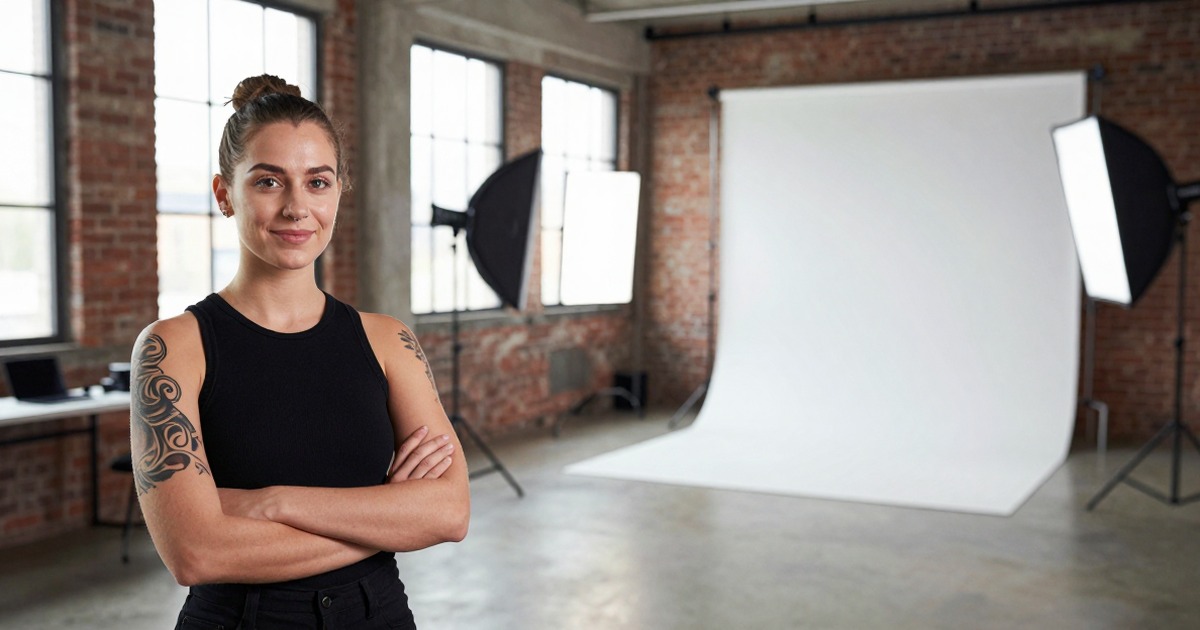
Professional headshots and visible tattoos have always had a complicated relationship. Traditional advice said cover everything. But that advice was written for a different era. In 2026, the conversation has changed significantly.
The question isn't whether tattoos and piercings are "acceptable" anymore. Over 30% of Americans have at least one tattoo, and that number climbs past 40% for adults under 40. Visible piercings are similarly common. For many professionals, tattoos and piercings aren't a style choice they made once. They're part of who they are.
The real question is: what does YOUR industry and audience expect? And with AI headshots, you have options that traditional photography can't easily offer.
The Flexibility AI Headshots Provide
Here's what makes AI headshots uniquely useful for tattooed and pierced professionals: you can generate multiple versions.
With traditional photography, you either cover your tattoos or you don't. You either remove your piercings for the shoot or you keep them in. That's your one set of photos.
With an AI headshot generator like Narkis.ai, you can generate different looks from the same training photos:
- Natural look: Your tattoos and piercings as they are. Authentic to you.
- Toned-down version: Same face, same expression, but with tattoos less prominent or piercings removed in the generated image.
- Context-specific versions: Different levels of visibility for different platforms.
This isn't about hiding who you are. It's about having options for different professional contexts, the same way you might wear a button-down to a client meeting and a t-shirt to a coworking space.
Industry-Specific Guidance
The "right" answer depends entirely on your field and your audience:
Tattoos and Piercings Welcome
Creative industries: Graphic design, music, photography, art, fashion. Visible ink and metal often signals that you're part of the creative community. Covering up can actually work against you.
Tech and startups: Most of the tech industry stopped caring about visible tattoos years ago. Silicon Valley dress codes have never excluded body art.
Fitness and wellness: Personal trainers, yoga instructors, and wellness coaches often have visible tattoos. In these fields, they signal authenticity and physical comfort.
Food and hospitality: Tattoo culture and restaurant culture have been intertwined for decades. A chef with sleeve tattoos is practically a cliché, in a good way.
Context-Dependent
Healthcare: Depends heavily on the practice and the patient population. A pediatric dentist might get different reactions than an emergency room nurse. Neither answer is wrong.
Education: Varies by institution, level (university vs. elementary), and geography. University faculty in creative departments? Fine. Elementary school in a conservative district? You might want options.
Legal: Big law firms still trend conservative. Solo practitioners and small firms are increasingly relaxed. Family law and criminal defense are more accepting than corporate law.
Financial services: Client-facing roles at traditional institutions tend conservative. Fintech, independent advising, and younger client demographics are more accepting.
Play It Safe
Government and military: Formal requirements often exist. Check your specific agency or branch guidelines.
C-suite at traditional companies: Executive headshots still tend toward conservative in Fortune 500 contexts. This is changing, but slowly.
Client work with unknown audiences: If you don't know who's viewing your headshot, a cleaner version gives you the widest safety margin.
How to Approach AI Training Photos
When uploading your selfies to train an AI model, include photos that show your tattoos and piercings naturally:
For tattoos:
- Include photos that show your tattoos at their normal visibility (short sleeves, etc.)
- Also include photos where they're less visible or covered (long sleeves, higher necklines)
- This gives the AI reference for both looks
For piercings:
- Include photos both with and without your piercings if possible
- The AI can learn your face with standard piercings (ears, nose stud) and generate either way
- Larger or more unusual piercings may appear in generated photos if they're in most training images
General tips:
- 15-20 photos with a mix of visibility levels gives the most flexible results
- Good lighting matters more than covering or revealing body art
- Natural expressions produce better results than posed ones
Making the Decision
Here's a framework for deciding whether to show or tone down tattoos and piercings in your professional headshot:
Show them if:
- Your industry and role accept them
- Your clients or audience would view them positively or neutrally
- They're part of your personal brand
- Hiding them feels inauthentic and that inauthenticity would come through
Consider toning down if:
- You're applying to roles or pitching clients in conservative industries
- You're unsure about audience reception
- The placement is distracting in a headshot format (face/neck tattoos in a head-and-shoulders crop)
- You want maximum versatility across different professional contexts
The "both" approach:
- Generate headshots with and without visible tattoos/piercings
- Use the authentic version for platforms and contexts where you feel comfortable
- Keep the cleaner version available for contexts that call for it
- Update both whenever you update one
What AI Gets Right and Wrong
Modern AI headshot generators handle tattoos and piercings with varying degrees of accuracy:
What works well:
- Small to medium tattoos on arms and shoulders
- Standard piercings (ear studs, small nose rings)
- Generating clean versions when tattoos weren't prominent in training photos
What can be tricky:
- Large, complex sleeve tattoos may be simplified or partially rendered
- Face and neck tattoos can confuse some AI models
- Unusual or large piercings (septum, industrial, stretched lobes) may not render accurately
- Very colorful tattoos might shift in hue
For best results with significant body art, use a generator that trains a personalized model on your specific photos. Generic AI tools handle tattoos poorly because they haven't learned YOUR specific ink. Narkis.ai trains on your uploaded photos, which means it learns your tattoos as part of your appearance.
The Bigger Picture
The professional headshot is evolving. What was "unprofessional" ten years ago is normal today. The trend line is clear: authenticity is winning over conformity in most industries.
But professional photography still operates in a "one look per session" model. AI headshots give you the flexibility to be authentic where you can and strategic where you need to be. That's not compromise. It's communication.
Your tattoos and piercings are part of your story. Your headshot should tell whatever chapter of that story fits the audience.