
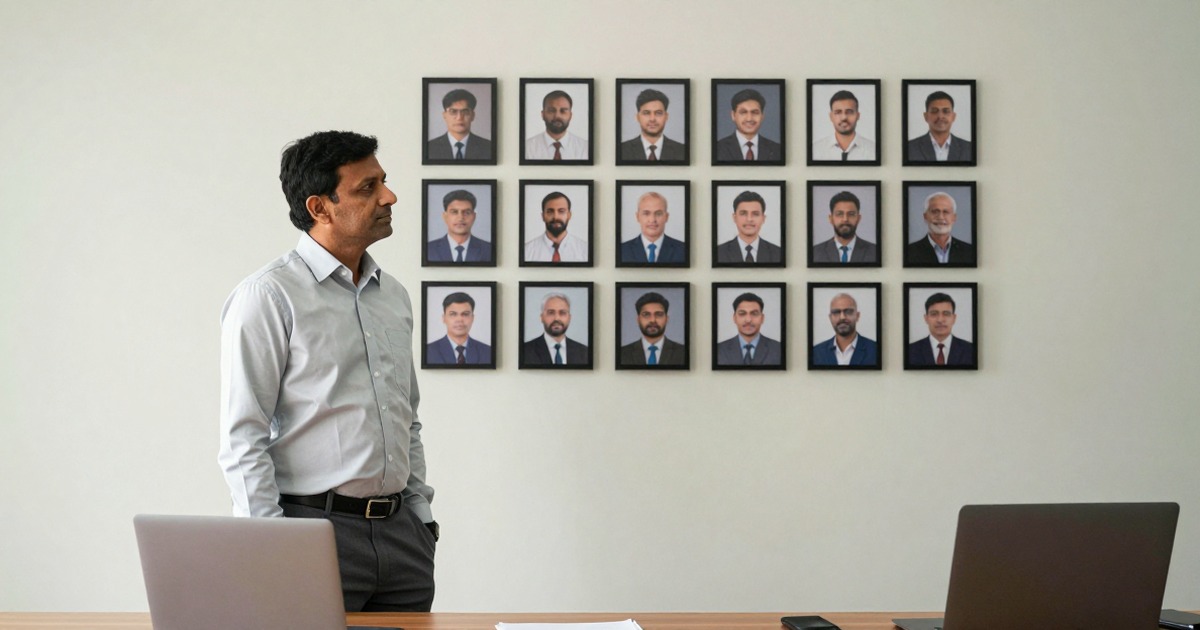
Most companies track office supplies down to the last pen. They measure time-to-hire, customer acquisition cost, employee retention rates. But almost none of them measure the cost of bad employee photos, even though those images touch nearly every revenue-generating interaction the company has.
The photos are everywhere. Website team pages. LinkedIn profiles. Email signatures. Conference speaker bios. Sales decks. Investor presentations. Every single one of these touchpoints shapes how clients, candidates, and partners perceive your company. And most companies are showing up with photos that range from "clearly taken on an iPhone in 2019" to "I'm not sure that person still works here."
The financial impact is real, measurable, and larger than most executives assume.
The Client Trust Problem
Clients make judgments fast. Research on first impressions shows that people form opinions about competence, trustworthiness, and professionalism within milliseconds of seeing a face. Those judgments stick.
When a potential client lands on your team page and sees a grid of mismatched photos, they draw conclusions. Three people in suits, two in hoodies, one visibly taken at a wedding, one that's clearly a decade old. The conclusions aren't good.
The company looks disorganized. It looks like it doesn't pay attention to details. It looks like the people running it couldn't get their act together long enough to take matching photos. If you can't coordinate something as simple as team headshots, why should a client trust you with their money?
This isn't hypothetical. Sales teams lose deals they never hear about. A prospect visits the site, sees the photo problem, and mentally downgrades the company from "serious contender" to "maybe if nothing else works out." They don't tell you. They just don't convert.
Even one percent of lost deals adds up fast. A B2B company closing $500K in annual deals only needs to lose three prospects per year for bad photos to cost more than fixing them would.
The Recruiting Penalty
Job candidates google your team before they apply. They look at LinkedIn profiles. They check the about page. They're trying to figure out if this is a place they can see themselves.
Bad photos send a message. Outdated images suggest the company doesn't invest in its people. Inconsistent quality suggests there's no standard, no attention to how the company presents itself externally. Low-quality photos make the company look cheap.
Top candidates have options. They're comparing you to companies that look polished, professional, and like they have their act together. If your team page looks like a collection of random Facebook profile pics, you're starting from behind.
The cost shows up as longer time-to-hire and lower acceptance rates on offers. You can't measure it directly, but recruiters know it when they see it. The candidate who was excited after the first call goes quiet after visiting the website.
The Internal Culture Signal
Employees notice when the company doesn't care about how they're represented. They notice when their photo is three years out of date, taken on someone's phone in a hallway, and sits next to a professionally shot image of the CEO.
It sends a signal about who matters. It tells people the company will invest in looking good at the executive level but won't spend $100 per person to make everyone else look professional.
This matters more than most leadership teams think. Employees talk. They compare notes. "They spent six figures on the rebrand but won't get us decent headshots" is the kind of thing that gets repeated in Slack channels and over lunch. It's a small thing that becomes a symbol of larger dysfunction.
The cost is harder to measure here, but it shows up in retention, engagement, and willingness to refer talented friends to open roles.
The "We'll Get Around to It" Tax
Most companies know their employee photos are bad. They've known for months. Sometimes years. The problem is always on the list, always gets pushed to next quarter.
Meanwhile, the cost compounds. Every prospect who visits the site. Every candidate who checks LinkedIn. Every conference where a speaker bio gets submitted with a photo that makes the company look second-rate. The damage accumulates daily.
The math is straightforward. A professional headshot costs between $150 and $400 per person if you hire a photographer for an on-site session. For a 20-person company, that's $3,000 to $8,000, depending on how much you care about quality.
Tools like Narkis.ai, starting at $27 per person, bring the cost down to under $600 for the same team. Either way, the total investment is less than one lost deal, one failed hire, or one frustrated employee who leaves because they don't feel valued.
Companies will spend that much on a single offsite lunch and not think twice. But somehow, employee photos stay in the "we'll get to it eventually" bucket for years.
Calculating the Real Cost
Here's a framework that makes the cost visible:
Lost revenue: Assume bad photos cost you one percent of inbound leads who would otherwise convert. For a company doing $2M in annual revenue, that's $20,000. Even at half a percent, the cost exceeds what professional team headshots would run.
Recruiting inefficiency: Add two weeks to average time-to-hire because candidates are less excited. For a role with a $100K salary, that's roughly $4,000 in lost productivity per hire. Three hires per year and you've spent another $12,000.
Employee retention: Lose one person per year who cites company image and professionalism as part of their reason for leaving. Replacement cost is typically 50 to 200 percent of salary. Even at the low end, that's $50,000 for a $100K employee.
Total annual cost from bad photos: $82,000 for a small company doing $2M in revenue. The fix costs under $10,000, even at the high end.
Most companies are losing money on this trade every single year and not tracking it.
The Fix Is Cheaper Than the Problem
The barrier isn't cost. The barrier is coordination. Getting everyone in the same place, finding a photographer, scheduling the session, dealing with people who hate being photographed.
AI headshot tools solve most of this. Employees upload a few selfies. The system generates professional headshots. No photographer, no scheduling nightmare, no one awkwardly standing in front of a backdrop in the conference room.
The output quality has caught up to traditional photography for standard business headshots. The cost is a fraction. The coordination burden drops to nearly zero.
For companies still tolerating bad employee photos, the question isn't whether to fix it. The question is why you haven't already.
FAQ
How often should employee photos be updated?
Every two to three years, or whenever someone's appearance changes enough that clients or candidates would notice. If the photo doesn't look like the person anymore, it's costing you trust.
What if employees don't want professional photos taken?
This isn't about vanity. It's about representing the company professionally. Every employee with a client-facing role or public profile needs a professional headshot. Make it non-negotiable and make it easy.
Can we just let people use their own photos?
You can, and you'll end up with the inconsistent mess that's costing you deals and hires. Consistency matters. Set a standard and enforce it.
Are AI headshots actually good enough?
For standard business headshots, yes. They won't replace high-end editorial photography, but for team pages, LinkedIn profiles, and email signatures, the quality is indistinguishable from traditional photography at a fraction of the cost.
How do we measure if new photos actually help?
Track conversion rates on team page visits, application rates after career page views, and client feedback during sales processes. The improvement won't be dramatic, but it will be measurable if you're paying attention.