
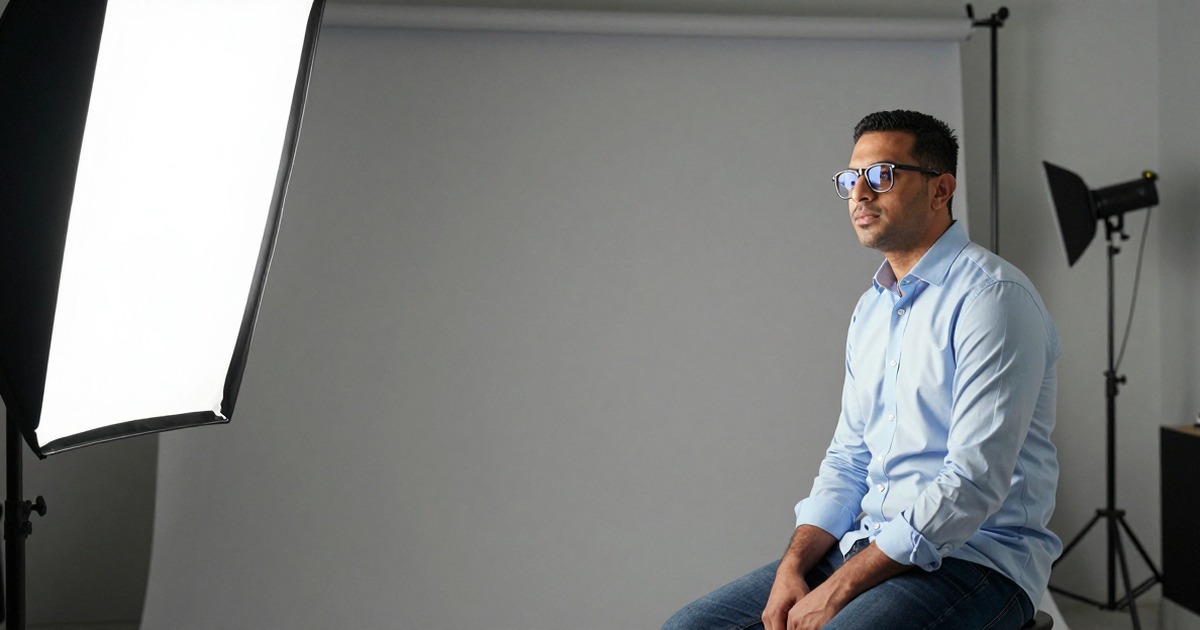
You wear glasses every day. Your colleagues know you with them. Your clients recognize you with them. So why would you take them off for your professional headshot?
The short answer is you shouldn't. But you do need to know how to manage them properly. Glasses introduce specific technical challenges that turn otherwise solid headshots into unusable images.
Why Studio Lights and Ring Lights Create Reflections
The problem isn't your glasses. The problem is physics.
Most artificial lighting setups use direct light sources positioned at predictable angles. Ring lights, softboxes, and even basic studio strobes all create bright, concentrated points of light. When these hit the curved surface of your lenses at certain angles, they reflect straight back into the camera.
The result is a bright white spot that obscures your eyes. This is the exact opposite of what a headshot should accomplish. Your eyes carry most of the communication weight in a portrait. Cover them with glare and the photo becomes worthless.
Photographers solve this in two ways. They adjust the lighting angle or they adjust your head position. Sometimes both. The goal is to change the reflection angle so the light bounces away from the camera instead of directly into it.
This is easier with larger, diffused light sources positioned above or beside the subject. Ring lights are notoriously difficult because the camera sits in the center of the light. This creates a direct reflection path that's hard to avoid.
Angle Adjustments That Actually Eliminate Glare
Small changes make the difference. You don't need to tilt your head dramatically or turn to the side. You need precision.
Start with chin position. Tilting your chin slightly down changes the angle of your lenses relative to the light source. This works especially well when the light is positioned above eye level, which is standard for most portrait setups.
Head rotation also helps. Turning your face 10 to 15 degrees to one side often shifts the reflection just enough to push it outside the frame or off your pupils. The photographer can shoot from a slightly offset angle to maintain good eye contact with the camera while keeping your glasses clear.
Avoid extreme tilts. Some people compensate for glare by tilting their head far down or to the side. This creates new problems like unflattering shadows under the chin, distorted facial proportions, or an awkward, unnatural look that signals amateur photography.
The best approach combines small adjustments to multiple variables. Slight chin tilt, slight head turn, and proper light positioning together eliminate glare without making you look stiff or uncomfortable.
When to Remove Glasses vs. When to Keep Them
Keep your glasses if you wear them daily. If you walk into meetings wearing them, if you're on video calls with them, if people identify you by them, then they belong in your headshot.
Remove them only if you wear them sporadically. Reading glasses that you put on and take off throughout the day don't define your appearance. Safety glasses you wear only in specific environments don't need to appear in a general professional photo.
The recognition factor matters more than aesthetics. A headshot serves as visual identification. If your glasses are part of how people recognize you, removing them creates a mismatch between your photo and your in-person appearance. This undermines the entire purpose of having a professional headshot.
Some people remove glasses because they think it looks more professional. This is backward thinking. What looks professional is consistency and authenticity. A clear, well-lit photo of you wearing your everyday glasses is more professional than a photo where you've removed a defining feature of your appearance.
Anti-Reflective Coating and Lens Considerations
Anti-reflective coating reduces but doesn't eliminate glare. The coating minimizes reflections from ambient light and helps with screen glare. However, it won't solve the problem of a bright studio light hitting your lenses at a direct angle.
AR coating does make the photographer's job easier. Reflections are less intense and easier to eliminate with minor position adjustments. If you're ordering new glasses and plan to take professional photos regularly, AR coating is worth the upgrade.
Lens thickness and shape also affect reflections. Thinner lenses with less curvature create smaller, more manageable reflections. High-index lenses generally perform better in portrait photography than standard plastic lenses.
Frame size and style matter less than you'd think. Large frames don't automatically create more glare, and small frames don't automatically create less. The angle of the lens relative to the light source determines glare, not the frame perimeter.
How AI Headshot Tools Handle Glasses
AI headshot generators handle glasses with mixed results. The technology has improved significantly, but limitations remain.
Most AI tools can preserve your glasses across generated images if you upload photos that consistently show you wearing them. The model learns that glasses are part of your appearance and includes them in the output.
The challenge is glare and reflection consistency. AI models sometimes generate unrealistic reflections or eliminate them entirely. This creates an unnatural look. Other times they add glare where none existed in the training photos, or they distort the frame shape slightly.
Narkis.ai handles glasses better than most platforms because it uses multiple training images to establish consistent features. Upload 10 to 15 photos where you're wearing the same glasses, and the model recognizes them as a permanent feature rather than an accessory. The system starts at $27 and produces professional results without requiring a studio session.
The key is input quality. If your training photos have inconsistent or heavy glare, the AI will struggle to produce clean outputs. Upload photos with clear, glare-free glasses and the results improve dramatically.
Common Mistakes People Make
Taking off glasses you always wear is the most frequent error. The second is tilting too far to compensate for glare. This creates an unnatural, uncomfortable posture that's immediately obvious in the final image.
Other common mistakes:
Using a ring light without adjustment. Ring lights are convenient but create the most difficult glare conditions for glasses wearers. You need to position yourself carefully or use additional diffusion to soften the reflections.
Forgetting to clean the lenses. Smudges and dust spots that are barely visible in person become obvious under bright studio lights. Clean your glasses thoroughly before the shoot.
Wearing old or damaged frames. Scratched lenses scatter light and create visual noise. Bent frames sit crooked on your face. If your glasses are worn out, replace them before your headshot session.
Ignoring the photographer's positioning instructions. If the photographer asks you to adjust your chin or turn slightly, they're working to eliminate glare. Small movements feel awkward but produce better results than staying in a comfortable position with visible reflections.
Choosing decorative or tinted lenses for the shoot. Transition lenses that darken in bright light will darken under studio lights. Tinted lenses create color casts. Stick with clear lenses for professional headshots.
Practical Steps for Your Next Headshot
Before the session, clean your glasses and inspect them for damage. If the frames are bent or loose, get them adjusted at an optical shop.
During the session, communicate with your photographer. Mention that you wear glasses daily and want them in the shot. A good photographer will adjust lighting and positioning to accommodate them.
Pay attention to angle recommendations. Small adjustments to chin position and head rotation make the difference between glare and clarity.
Review test shots. Most photographers will show you initial images so you can verify there's no glare. Don't skip this step. What looks like minor glare on a small preview screen can be unusable in a high-resolution final image.
If you're using an AI headshot service, select your training photos carefully. Choose images where your glasses are clearly visible and free from heavy reflections. Consistency across training images produces better results.
FAQ
Should I bring a backup pair of glasses to my headshot session?
Only if you regularly wear different frames in professional settings. Otherwise, stick with your everyday glasses. The goal is authenticity, not variety.
Can glare be removed in post-processing?
Light glare can be reduced in editing, but heavy reflections that completely obscure your eyes are difficult or impossible to fix convincingly. Better to eliminate glare during the shoot than rely on post-processing.
Do I need special anti-glare glasses for photography?
No. Standard anti-reflective coating is sufficient. Specialized photography glasses exist but aren't necessary for typical professional headshots.
What if I wear both glasses and contacts?
Wear whichever you use more frequently in professional settings. If you alternate regularly, consider taking separate headshots with each so you have options that match different contexts.
Will glasses make my headshot look less professional?
No. Glasses have no impact on professionalism. Poor lighting, glare, or removing glasses when you always wear them will make your headshot look less professional. Clear, well-lit glasses enhance rather than detract from a professional image.